The terrifying reality of seeing an 18-wheeler fail to stop on a busy route like I-565 is something no driver ever forgets. When a commercial truck approaches a congested intersection and the heavy-duty brakes give out, the resulting collision inevitably causes catastrophic property damage and severe physical trauma.
For those living and navigating the daily commutes throughout the Tennessee Valley, heavy commercial traffic is simply an unavoidable reality. The local economy relies heavily on logistics hubs and manufacturing facilities, meaning passenger vehicles share the road with massive transport carriers every single day.
The dangerous relationship between excess cargo weight and failing braking systems is a well-documented hazard in the commercial transportation industry. When freight companies intentionally push their fleets past statutory weight limits to minimize transportation costs, they knowingly compromise the mechanical integrity of their vehicles. This deliberate choice turns standard delivery routes into deadly hazards, stripping the driver of the ability to control the vehicle during an emergency stopping maneuver.
Why Do Commercial Truck Brakes Fail on Alabama Highways?
Commercial truck brakes typically fail on Alabama highways due to a combination of excessive cargo weight, poor routine maintenance, and driver error. When a tractor-trailer carries too much freight, the immense friction generated during stopping maneuvers overheats the air brake system, leading to catastrophic brake fade and collision.
The Federal Motor Carrier Safety Administration tightly regulates the maintenance standards for massive transport vehicles operating across state lines. Under 49 CFR Section 393.40, all commercial motor vehicles must maintain adequate service, parking, and emergency braking capabilities at all times. Tractor-trailers utilizing modern air brakes must also adhere to strict requirements that force the automatic application of emergency brakes if the internal air pressure drops below a critical threshold, typically between 20 and 45 psi.
Despite these comprehensive federal mandates, catastrophic system failures remain a persistent and deadly threat on local interstates. Air brake systems rely entirely on highly pressurized air to apply the necessary mechanical force to stop an 80,000-pound load.
When these complex systems are ignored during routine fleet maintenance or are pushed beyond their physical operational limits by excess tonnage, the margin for error disappears completely. Common mechanical failures that lead directly to highway disasters include:
- Glazed brake pads that lose their ability to grip the steel drum due to overheating
- Air line leaks that slowly bleed vital operational pressure from the primary system
- Out-of-adjustment pushrods that dangerously delay the application of stopping force
- Worn compressor valves that fail to replenish the air supply rapidly enough during heavy traffic
When a fully loaded 18-wheeler merges onto I-65 or navigates the busy commercial corridors of Huntsville, compromised mechanical parts drastically increase the distance required to stop. Commercial operators are legally required to perform thorough pre-trip inspections to catch these exact mechanical issues before putting the truck in gear. Skipping these mandatory checks to save a few minutes of time puts every surrounding passenger vehicle in the immediate vicinity at immense risk of a rear-end collision.
What are the Legal Commercial Truck Weight Limits in Alabama?
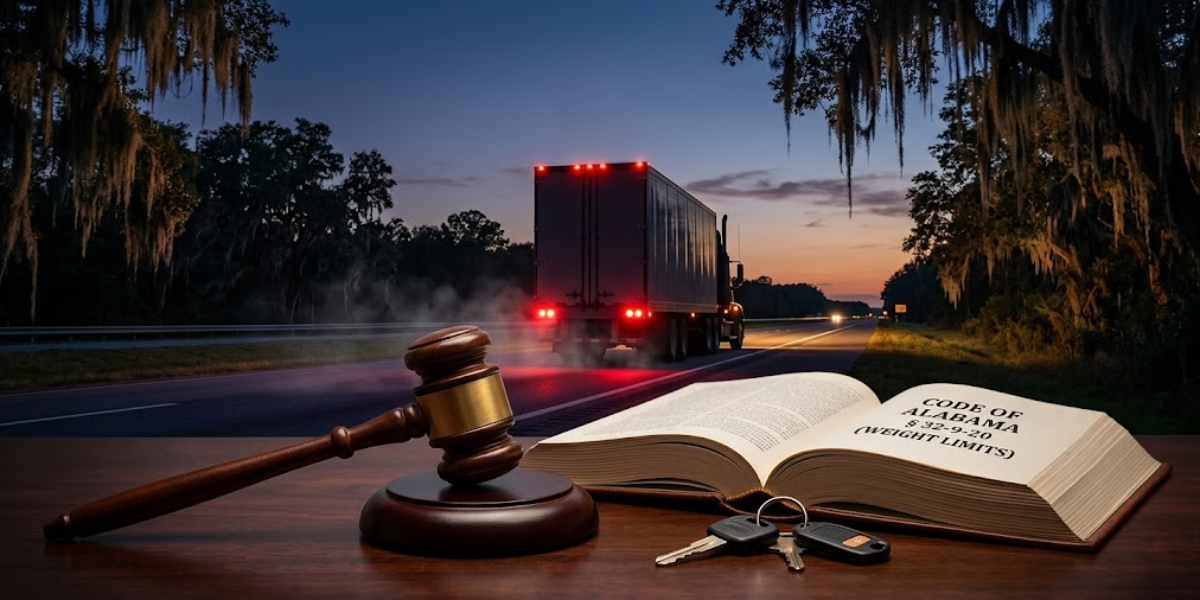
Under Alabama Code Section 32-9-20, the gross vehicle weight limit for an 18-wheeler on interstate highways is strictly capped at 80,000 pounds. A single axle cannot carry more than 20,000 pounds. Exceeding these legal limits places dangerous stress on the truck’s mechanical systems and significantly extends stopping distances.
State lawmakers established firm regulatory boundaries to protect the structural integrity of local infrastructure and to ensure basic public safety on shared roadways. You can find these exact operational specifications detailed within the Alabama Code Section 32-9-20 framework, which mandates that tandem axles carry no more than 34,000 pounds.
While some specific state highways and non-interstate routes occasionally permit up to 84,000 pounds for specialized vehicles equipped with six or more load-bearing axles, the fundamental physics governing heavy transport remains unchanged. The heavier the commercial truck, the harder it is for the mechanical systems to bring it to a safe halt.
A fully loaded, legally compliant commercial truck traveling at standard highway speeds requires roughly the length of two full football fields to come to a complete stop. When a negligent shipping broker overloads a trailer by an extra ten thousand pounds to avoid making a second trip, that stopping distance increases exponentially.
The kinetic energy generated by an overweight big rig traveling at sixty-five miles per hour is practically incomprehensible. Standard passenger sedans and family SUVs are simply not engineered to withstand the crushing forward force of an overloaded tractor-trailer failing to stop at a red light on University Drive. The extra mass pushes the trailer forward, demanding more braking power than the system was ever designed to provide.
How Does Excess Weight Directly Destroy Air Brake Systems?
Excess cargo weight destroys commercial air brakes by generating uncontrollable thermal energy. When an overloaded 80,000-pound truck attempts to stop quickly, the immense friction heats the brake drums beyond their operational capacity. This heat expansion prevents the brake shoes from making contact, resulting in a complete inability to stop.
The catastrophic mechanical breakdown caused by excessive cargo weight is universally known in the transportation industry as brake fade. Heavy commercial trucks do not utilize hydraulic fluid systems like the standard passenger cars sitting in your driveway. Instead, they rely on heavy-duty compressed air to physically push a thick friction shoe against a rapidly spinning steel drum. This highly forceful physical contact generates extreme levels of friction and thermal energy.
Under normal, legally compliant operating conditions with a properly loaded trailer, the heavy steel drums absorb and efficiently dissipate this thermal energy into the surrounding rushing air. However, when a greedy fleet manager intentionally overloads the cargo bay to maximize an invoice, the entire pneumatic system must work much harder to fight the momentum.
The steep highway grades and mountainous terrains found throughout certain areas of North Alabama only exacerbate the problem, as gravity forces the operator to ride the pedal continuously to prevent accelerating downhill. Because of the excess weight, the internal temperature of the drum quickly spikes past safe operational limits.
As the metal severely overheats, it physically expands outward and away from the friction shoe. The driver can press the brake pedal completely to the floor of the cab, but the expanded drum can no longer be reached. The massive vehicle essentially becomes a runaway missile. Absolutely no amount of evasive driving skill can correct this physical reality once thermal expansion has occurred.
Who Is Held Liable for an Overweight Truck Crash?
Liability in an overweight truck crash extends beyond the driver to multiple corporate parties. The trucking company can be held responsible for poor maintenance, while the freight loaders or shipping brokers may be liable for intentionally overloading the trailer beyond federal safety limits to maximize their profits.
After a devastating highway collision, the immediate public assumption is often to direct all the blame toward the person sitting behind the steering wheel. While the commercial operator certainly holds a strict duty of care while on the road, commercial trucking is a massive, multi-layered corporate enterprise. A thorough and aggressive legal investigation frequently reveals a deep chain of negligence stretching far beyond the chaotic scene of the wreck.
Identifying every single responsible corporate entity is absolutely necessary for securing comprehensive financial recovery for catastrophic injuries. When an attorney files a formal complaint on your behalf, they systematically evaluate the actions and decisions of everyone involved in putting that specific unsafe truck on the road. The list of potentially liable corporate parties frequently includes:
- The commercial driver who completely failed to recognize the obvious weight discrepancy or skipped the mandatory pre-trip brake inspection protocol
- The motor carrier or trucking company that failed to perform required preventative fleet maintenance or ignored driver complaints about soft pedals
- The independent freight loading facility that packed the trailer well beyond its safe operational capacity simply to save on transportation costs
- The third-party mechanical maintenance vendor that fraudulently signed off on heavily worn or severely out-of-adjustment air systems
Unraveling this complex web of shared corporate liability prevents the massive defense firm from simply firing a rogue driver while the company continues operating dangerous vehicles across the state.
How Does Alabama’s Contributory Negligence Law Impact Truck Crash Claims?
Alabama enforces a strict pure contributory negligence doctrine, meaning if an insurance company proves you were even one percent responsible for the accident, you are barred from receiving compensation. Defense adjusters frequently use this law to blame victims for minor infractions to completely deny catastrophic injury claims.
Recovering financial damages in this specific state presents unique and highly frustrating legal hurdles not found in the vast majority of other jurisdictions. Across most of the country, courts apply comparative fault rules where your financial compensation is simply reduced by your specific percentage of blame.
Here, the legal standard operates on an absolute, all-or-nothing basis. If a civil jury determines that a speeding commercial truck was ninety-nine percent at fault for the crash, but you were deemed one percent at fault because you changed lanes slightly too early, you walk away with nothing.
Massive insurance corporations immediately weaponize this harsh legal doctrine following a severe commercial collision. An aggressive defense adjuster will meticulously review intersection traffic camera footage or parse your recorded telephone statements looking for any polite apology or slightly misremembered detail. They will desperately attempt to argue that you stopped too suddenly, failed to use a turn signal, or did not take proper evasive action quickly enough when the runaway truck approached your rear bumper.
Overcoming these bad-faith assertions requires substantial time and undeniable proof. Experienced legal counsel systematically dismantles these defense tactics by securing hard evidence that the commercial operator and their corporate employer were entirely to blame for the catastrophic event, leaving the insurance company no room to shift the blame onto your shoulders.
What Evidence Proves a Trucking Company Ignored Safety Rules?
Proving a trucking company ignored safety regulations requires securing specific corporate evidence immediately after a crash. Your legal team will subpoena the truck’s electronic control module data, weigh station receipts, maintenance logs, and the driver’s hours-of-service records to uncover exactly why the brake failure occurred.
Physical evidence at a violent crash scene vanishes remarkably fast. Dark tire skid marks wash away with the next heavy rainstorm, shattered debris is quickly swept off the shoulder of the highway, and traffic camera footage from busy intersections in Madison or Huntsville is routinely overwritten by the city within days.
To decisively prove that excess cargo weight or ignored maintenance directly caused the wreck, immediate legal action is required to preserve internal corporate documents before they conveniently disappear from the filing cabinet.
Modern commercial trucks are highly monitored, data-rich machines. The exact evidence needed to prove corporate negligence almost always exists, but it must be legally compelled from the carrier’s possession. Your legal team will immediately draft and send a strict spoliation letter demanding the preservation of:
- The electronic control module, often called the black box, detailing the truck’s exact speed, RPMs, and braking force in the critical seconds before impact
- Official state weigh station tickets, bills of lading, and shipping manifests proving the exact cargo payload carried at the time
- The driver’s electronic logging device showing mandatory hours of service to highlight potential driver fatigue
- Internal fleet maintenance logs and repair invoices detailing exactly when the brake drums were last inspected, serviced, or replaced by a mechanic
Securing this highly specific documentation transforms a complex personal injury case from a simple debate over what happened into an undeniable factual presentation of deliberate corporate negligence.
How Long Do I Have to File a Truck Accident Lawsuit in Alabama?
Under Alabama Code Section 6-2-38, victims of commercial truck crashes have exactly two years from the date of the collision to file a formal personal injury lawsuit. Missing this absolute deadline permanently extinguishes your right to pursue financial compensation against the negligent trucking company or its insurers.
The civil legal system operates on incredibly strict procedural timelines, and waiting too long to pursue a valid claim is one of the most devastating mistakes an injury victim can make. The statute of limitations establishes a hard, unforgiving boundary for your financial recovery.
The Alabama Code Section 6-2-38 outlines this two-year window with absolute clarity. Once the two-year anniversary date of the crash passes, the local court permanently loses all jurisdiction to hear your case, and the opposing insurance company will immediately close their file without paying a single dime.
While twenty-four months might initially sound like a long time to make a decision, building a comprehensive commercial liability case consumes many months of dedicated work. The initial accident investigation phase, complex medical treatment, and aggressive back-and-forth negotiations take significant time to navigate properly.
If the defense adjuster stubbornly refuses to offer a fair settlement valuation that covers your mounting medical debt, your legal representation must thoroughly draft the legal complaint and formally file it at the Madison County Courthouse, the Lauderdale County Courthouse, or the appropriate legal venue before the statutory deadline strikes. Engaging knowledgeable legal counsel early ensures these critical procedural rules are handled securely while you focus your energy entirely on physical rehabilitation.
What Compensation Is Available for Catastrophic Injury Victims?
Victims of catastrophic commercial truck crashes in Alabama can pursue comprehensive financial compensation. This recovery covers past and future medical expenses, lost earning capacity, physical rehabilitation costs, and significant pain and suffering resulting from the trucking company’s negligent safety practices.
The physical and economic aftermath of a direct collision with an 80,000-pound machine is rarely minor. Accident survivors frequently face life-altering traumatic brain injuries, permanent spinal cord damage, and complex compound fractures that require years of dedicated, highly expensive medical intervention. The fundamental purpose of a civil personal injury claim is to make the injured victim financially whole again by shifting the massive economic burden entirely onto the corporate parties responsible for causing the harm.
Accurately calculating these profound damages requires immense patience and attention to detail. Your legal counsel will purposefully wait until you reach Maximum Medical Improvement, or MMI, before ever submitting a formal demand package to the insurance carrier. MMI is the highly critical medical milestone where your treating orthopedic surgeons and specialists determine that your physical condition has stabilized and your long-term medical prognosis is abundantly clear.
Rushing to accept a fast settlement check before reaching MMI risks leaving you personally responsible for funding future surgical procedures out of your own pocket. A meticulously prepared financial demand will properly account for the initial trauma center visits at Huntsville Hospital, the long-term physical therapy sessions, the career wages lost while you were unable to clock in, and the profound daily physical pain you endure simply because a transportation company decided to overload a commercial trailer.
When an overloaded commercial vehicle causes sudden devastation, you need strong, local legal representation to fight back against aggressive corporate insurance tactics. The attorneys at Hodges Trial Lawyers proudly represent injury victims across Huntsville, Florence, and the greater North Alabama region.
We handle all personal injury matters on a strict contingency fee basis, which means you pay absolutely no attorney fees unless we successfully win your case or secure a financial settlement on your behalf. Contact our office today at 256-539-3110 to schedule your free, confidential consultation.
Frequently Asked Questions
Can I still sue if the truck driver claims the brake failure was a sudden, unavoidable emergency?
Yes, you can still pursue a claim. The sudden emergency defense rarely holds up in commercial trucking cases if your legal team can prove the brake failure was caused by poor maintenance or excessive cargo weight. Neglecting routine inspections makes the mechanical failure entirely preventable, not a sudden surprise.
How do investigators determine the truck’s exact cargo weight at the time of the crash?
Attorneys secure the official bill of lading, shipping manifests, and state weigh station receipts through the legal discovery process. These corporate documents clearly list the requested payload, exposing any discrepancies between the safe operating limits and what was actually loaded into the trailer.
Will my case need to go to a jury trial against the trucking company?
Most commercial injury claims are settled out of court through intense negotiation or formal mediation sessions. However, if the insurance carrier refuses to offer adequate compensation for your long-term medical needs, taking the case before a jury becomes the necessary step to secure the funds you deserve.
What should I do if the trucking company’s insurance adjuster calls me directly?
You should politely decline to answer their questions and immediately end the phone call. Insurance adjusters are trained to extract conversational statements that can be twisted against you under the pure contributory negligence rule. Direct all communication through your chosen legal counsel to protect your injury claim.
Does a commercial driver’s logbook track vehicle maintenance issues?
Yes, drivers are required by federal law to complete Driver Vehicle Inspection Reports daily. If they noted soft brakes or air line leaks in their logbook and the company forced them to drive anyway, this documentation becomes powerful evidence of direct corporate liability.